


Borders always make us think about who we are and what might lie on the other side of the frontier. To paraphrase Fernand Braudel, when we slip over the border, we change. We are suddenly foreigners. And that's a theme we play with in several articles in this issue of hidden europe.


hidden europe 33
In this thirty-third issue of hidden europe magazine we ride Europe's longest urban bus route, explore the Polish port city of Szczecin, ponder the value of borders as cultural assets and take a look at Brittany's parish closes.
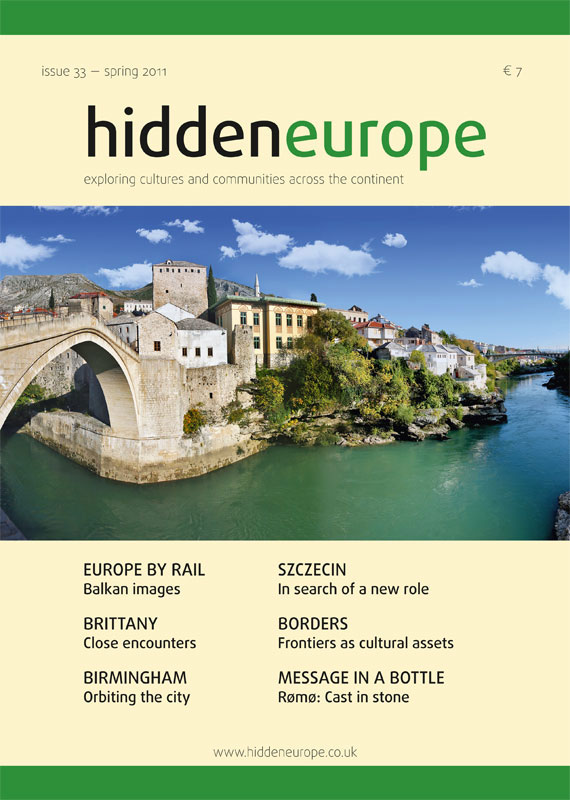
Picture above:
Bridge at Mostar, Bosnia-Herzegovina (photo © Neyo).
Summary
In this thirty-third issue of hidden europe magazine we ride Europe's longest urban bus route, explore the Polish port city of Szczecin, ponder the value of borders as cultural assets and take a look at Brittany's parish closes.

Birmingham's Outer Circle bus route is a veteran among urban bus routes, dating back to the nineteen-twenties. How many Brummies who ride the Outer Circle realise that this is Europe's longest urban bus route? Probably very few. But this extraordinary bus route provides a wonderful kaleidoscope of Birmingham life as it makes a great orbit through the suburbs of England's second city.

The shipyards in Szczecin once built some the world's finest and fastest passenger liners. But today the cranes are silent, and the city of Szczecin is struggling to define its role in modern Poland. The Baltic port city is a gritty place, and all the more interesting for that.

Borders have become something of a rarity in modern Europe. We can now travel by car from northern Norway to the Mediterranean without ever once having to show a passport. Political frontiers have faded, yet cultural frontiers remain. We reflect on the role of borders in Europe today and note how erstwhile lines of division are now recast as assets for the future.

The church enclosures of Finistère are spectacular pieces of architecture, marking progress from the material world (the village beyond the church) to a more spiritual realm. Patricia Stoughton has been exploring the far end of Brittany to unravel the symbolism and stories of the enclos paroissiaux (parish closes).

Urban explorer Duncan Smith escorts us on a journey below the streets of Cologne to see the city’s well-appointed sewers.

hidden europe editors Nicky Gardner and Susanne Kries showcase a new book which they have edited. Europe by Rail: The Definitive Guide for Independent Travellers was published in March 2011. This well-established title from Thomas Cook Publishing now has a very new look, and here the editors present extracts from a Balkan rail journey that features in the book.

The Danish island of Rømø is full of reminders of its erstwhile connections with the whaling industry. There are fence posts made of whalebones, and the skull of a whale stands beside the main road across the island.
Kintyre Express, the shipping offshoot of Scottish bus company West Coast Motors, has an ambitious plan to create a new fast ferry link between the Mull of Kintyre and the Antrim coast of Northern Ireland. We take a closer look.

So why does a statue of Rocky Balboa stand in a small town in northern Serbia? And why did citizens of Mostar (in Herzegovina) decide that a statue of Bruce Lee could unite their troubled town? We take a look at statues that seem improbably out of place.

You probably would have no very clear idea what currency is used in Nagorno Karabakh, no indeed whether you need to tip the barber next time you stop off for a short back and sides in deepest Chechnya. We ponder the knotty business of currencies and reflect on tipping etiquette.

The North Atlantic island that was once home to Christopher Columbus is a mainstream tourist destination. But that did not stop Europe's media from inventively recreating it as a remote desert island to make a good news story.
The Stettiner Haff or Szczecin Lagoon is one of Europe's unsung water bodies, a vast area of shallow saline water that is home to many birds. Seasonal ferry services cross the lagoon in the summer months, allowing travellers to explore this remote area on the German-Polish border.
A line of red and green Russian border-posts skirt the Norwegian Parliament building in Oslo. Politicians turn and look, as do casual passers-by. It is a quiet reminder that Norway really does share a common land border with Russia.

There is one very good reason for travelling by ferry to the Russian city of St Petersburg. For a short stay, ferry travellers are generally exempt from Russia's otherwise strict visa rules. So no surprise perhaps that St Peter Line, which already operates ferries from Helsinki to St Petersburg, is now adding new routes from Stockholm and Tallinn.
A look ahead at hidden europe 34 which will be published on 15 July 2011.