



Welcome to hidden europe 28. The issue contains articles on the Belarusian city of Vitebsk, Zagreb's literary ghosts, the Italian port city of Genoa, the Luxembourg village of Schengen and the small French town of Wissembourg.


hidden europe 28
The issue contains articles on the Belarusian city of Vitebsk, Zagreb's literary ghosts, the Italian port city of Genoa, the Luxembourg village of Schengen and the small French town of Wissembourg.
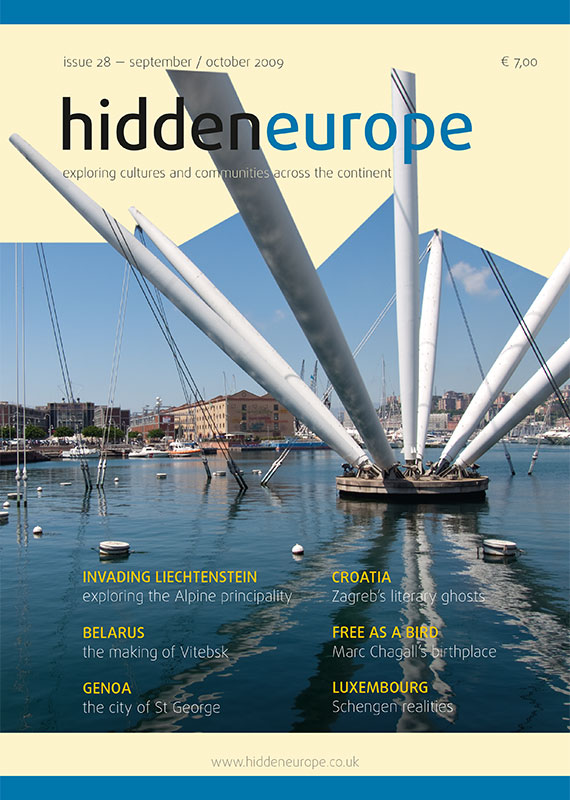
Picture above:
The Bigo is an architectural installation that now dominates the Porto Antico area of Genoa's waterfront (photo © hidden europe).
Summary
The issue contains articles on the Belarusian city of Vitebsk, Zagreb's literary ghosts, the Italian port city of Genoa, the Luxembourg village of Schengen and the small French town of Wissembourg.

Liechtenstein is one of Europe's unsung territories: a tiny Alpine principality by-passed by most travellers. We follow the route of an army of Russian soldiers that sought sanctuary in Liechtenstein in May 1945.

While many European cities decorate their squares and boulevards with statues of kings and generals in heroic poses, Zagreb takes a different tack. The Croatian capital gives its prime spots to poets, philosophers and novelists. Rudolf Abraham takes us on a tour of Zagreb's literary ghosts.

Tumbling off the train and riding the trolleybus over to the other side of the river is a fine introduction to Vitebsk. The Belarusian city is precise and orderly: Swiss efficiency colliding with Soviet style. And at the annual Slavianski Bazaar, Vitebsk is a city that knows how to party.

Schengen gave its name to two important European accords that paved the way for passport-free travel across much of Europe. Yet the Luxembourg village that gave its name to those treaties remains curiously unknown.

Fountains and flowers, neatly swept alleys, French sentences flowing into Alsatian German and back again, plus the inevitable choucroute, all combine to make Wissembourg one of Europe's most appealing small towns.

The birthplace of Karl Marx is, a little improbably it might seem, in the Moselle city of Trier. It is a place that nowadays seems irredeemably bourgeois. Yet Marx' legacy is superbly documented in Trier's Karl-Marx-Haus.

Do you remember Chagall's picture The Red Jew? The subject of Marc Chagall's painting recalls what he remembers of the artist's life in the city of Vitebsk.

Jewish passengers travelled hard class on the railways of eastern Europe one hundred years ago, enjoying none of the comforts of soft sleeping cars, but creating in the Russian train a very Jewish space - a perfect setting for Yiddish story telling.

A mountain community in Liguria has exploited a little legal loophole in European history to assert its independence. Welcome to the Principality of Seborga.
Is the Baltic the new Med? Or Bridlington the new St Tropez? Come now, we don't write about that sort of thing in hidden europe. But we do like to keep in touch with mainstream travel writing. And we find that in Britain the travel pages are full of lists.

The port city of Genoa commanded huge influence on account of its mercantile acumen and its early schemes for the management of public debt, which paved the way for modern banking. Today the city of St George still has the face of business.

A nineteenth-century nature reserve on the dry steppes of southern Ukraine was a pioneering example of early nature conservation in Europe. The feathery grasses still dance to the local winds at Askania-Nova.

Pluto must be very small and very far away. And so it is in Davor Preis' ingenious model of the solar system that invisibly orbits Zagreb and its suburbs.
The complex story of the Belarusian language and its flexible deployment of three different alphabets deserves to the better known. Early Belarusian texts in the Arabic script (called kitabs) are a remarkable part of Europe's cultural heritage.
Investments in cross-border roads in remote and rural areas of the European Union are much to be welcomed. But where are the bus services that should be plying those routes to connect communities across borders?
A look ahead at hidden europe 29