



Welcome to hidden europe 18. This issue of hidden europe travel magazine covers articles on sworn virgins in Albania, the Vrbas valley Bosnia, the city of London. new lakes in Lusatia and more besides.


hidden europe 18
This issue of hidden europe travel magazine covers articles on sworn virgins in Albania, the Vrbas valley Bosnia, the city of London. new lakes in Lusatia and more besides.
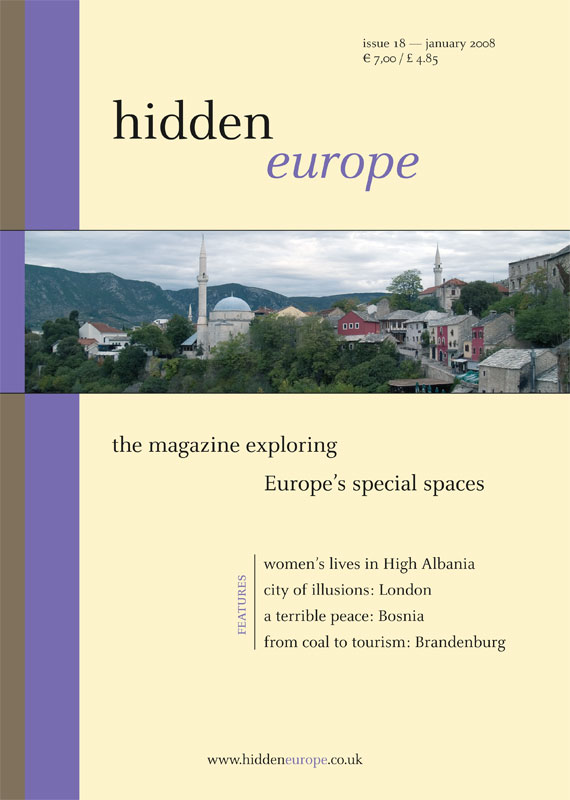
Picture above:
The old city of Mostar in Bosnia and Herzegovina (photo © hidden europe).
Summary
This issue of hidden europe travel magazine covers articles on sworn virgins in Albania, the Vrbas valley Bosnia, the city of London. new lakes in Lusatia and more besides.
Under the kanun code, which governs life in the mountains of northern Albania, women do not inherit. They barely even have a name. Yet, under certain circumstances, it is possible for women to break free from this patriarchal strait-jacket. Join us as we explore the world of Albania's sworn virgins.
The City of London - the very heart of the English capital - has long been a melting pot for cultures and religions. And today the area has striking contradictions in wealth and social status. We report from the city of illusions.
The Dayton Accord may have been a sensible way of bringing a terrible war in Bosnia to an end. But what of the peace ushered in by Dayton? We examine life in Muslim communities in the Vrbas valley in central Bosnia.
We take a look at an extraordinary landscape regeneration programme that is bringing new life to a former industrial region in eastern Germany. Where once coal was king, now new lakes are being created to promote tourism. And what about the mighty F60?
Many modern shopping centres are parodies of the elegant glazed arcades that were, in many nineteenth-century European cities, focal points for shopping and relaxation. From Brussels to Milan, Cardiff to Genoa the arcaded gallery became a byword for style. Many of the best still survive.
Had you realised that it is not compulsory to take the fast train? Comb the timetables, and you still find the lazy slowcoach of a train that dawdles from one country station to the next. We celebrate the delights of the slow train.
With the expansion of the Schengen zone to encompass nine more countries, Europe's borders are fading fast. Communities once divided by international frontiers are happily united. But there is a downside, for fading borders within the European heartland are creating some formidable frontiers further east in Europe.
Take one village, a seemingly pleasant and unassuming place not far from the Danube. Look more closely, and there is more to life in Lovas than first meets the eye.
Public transport is often a fine way to get a feel for a foreign city. We take a look at a circular tram route in Helsinki that takes in most of the city's main sights.
Fámjin is all the better for being difficult to reach. It is a tiny place, a mere pinprick on the map of the Faroes. But Fámjin has something of the Faroese soul about it, for it here that the national flag was first flown. We look at some places that enshrine icons of national identity.
The vestiges of Jewish life and culture are waiting to be discovered in southeast France. From hill towns in the Dauphiné to old synagogues in Cavaillon and Carpentras, there are remnants of Les Juifs du Pape (the Pope's Jews).
Yet more on palindromes! Yes, we really like palindromes. This time one from London.
A good train timetable is a book to cherish. So when the British authorities decided that printing a national train timetable was a waste of time and money, we were distraught. Fortunately, a latter-day Bradshaw has stepped in to fill the gap.
There are about two dozen remaining fine examples of Norwegian stave churches. Most are in Norway. But one of the best is, somewhat improbably, in the mountains on the Polish-Czech border.
a look ahead at hidden europe 19